Leaves of Grass
Whitman's central and defining work, first published in 1855 and revised throughout his career.
Author guide
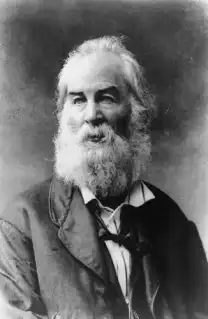
Walt Whitman (1819–1892) was an American poet, essayist, journalist, and fiction writer. Best known for Leaves of Grass, he developed an expansive democratic poetic voice and published influential poetry, prose, Civil War writings, criticism, and autobiography.
Catalog record updated .
Not sure where to begin?
Whitman's central and defining work, first published in 1855 and revised throughout his career.
Outside the series
war-memoir · 1876
memoir-and-prose-collection · 1882
political-pamphlet · 1856
essay · 1871
poetry-pamphlet · 1871
poetry-pamphlet · 1872
poetry-collection · 1855
Leaves of Grass is a poetry collection by American poet Walt Whitman. First published in 1855, Whitman spent most of his professional life writing and rewriting Leaves of Grass, revising it multiple times until his death. There have been…
poetry-collection · 1865
poetry-collection · 1865
poetry-collection · 1871
prose-and-poetry-collection · 1876
prose-and-poetry-collection · 1888
Many of the earliest books, particularly those dating back to the 1900s and before, are now extremely scarce and increasingly expensive. We are republishing these classic works in affordable, high quality, modern editions, using the…
prose-and-poetry-collection · 1891
prose-collection · 1892
Walt Whitman was born on May 31, 1819, in West Hills, Long Island, New York. He died on March 26, 1892, in Camden, New Jersey.
Source: nps.gov (opens in a new tab)
In Washington, D.C., Whitman worked as a government clerk and volunteered in military hospitals, visiting wounded soldiers, dressing wounds, and offering comfort.
Sources: nps.gov (opens in a new tab)poetryfoundation.org (opens in a new tab)
His writing was shaped by American travel and his interest in democracy, nature, city life, religion, music, and public speech. Ralph Waldo Emerson was a particularly important influence, while Biblical poetry helped shape Whitman's long, irregular lines.
Sources: poetryfoundation.org (opens in a new tab)neh.gov (opens in a new tab)loc.gov (opens in a new tab)
Whitman wrote about erotic love between men and was attracted to men, but applying a modern label such as "gay" to a nineteenth-century person is historically complicated. Biographical sources therefore describe the evidence and ongoing scholarly debate rather than treating a present-day identity category as a simple fact.
Sources: nps.gov (opens in a new tab)guides.loc.gov (opens in a new tab)whitmanarchive.org (opens in a new tab)
Whitman helped establish a distinctly American poetic voice through free verse, expansive lines, and poems centered on democracy, the body, and ordinary people. His work influenced later poets and remains central to the history of American poetry.
Sources: loc.gov (opens in a new tab)poetryfoundation.org (opens in a new tab)