Candide, ou l'optimisme
Voltaire's most accessible and widely read philosophical tale.
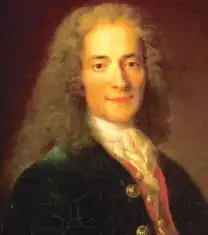
Author guide
Voltaire was one of the central writers of the French Enlightenment. Across a career of more than six decades, he produced plays, epic and satirical poetry, philosophical tales, histories, scientific and philosophical essays, religious criticism, political pamphlets, literary criticism, and autobiographical writing. His work is marked by advocacy of civil liberties, religious toleration, freedom of expression, empirical inquiry, and reform of criminal justice, together with a vigorous opposition to fanaticism and arbitrary authority.
Catalog record updated .
Not sure where to begin?
Voltaire's most accessible and widely read philosophical tale.
A concise entry into his views on religion, politics, science, literature, and English society.

A focused statement of his case for religious toleration and reform of judicial abuse.
A representative selection of his compact, satirical philosophical arguments.
The best starting point for his influential philosophy and practice of history.
Outside the series
philosophical tale · 1714
history · 1731
literary biography · 1738
history · 1756
philosophical tale · 1746
philosophical tale · 1747
philosophical tale · 1747
The 18th of the Month Scheval, in the Year of the Hegira, 837. Thou Joy of ev'ry Eye! Thou Torment of every Heart! Thou Intellectual Light! I do not kiss the Dust of thy Feet; because thou seldom art seen out of the Seraglio, and when…
philosophical tale · 1752
Après une étape sur Saturne où il se fait un compagnon de voyage, philosophe comme lui, Micromégas, habitant de Sirius, vient visiter la terre des hommes, " notre petite fourmilière " : occasion de péripéties nombreuses et de dialogues…
history · 1753
history · 1751
philosophical tale · 1756
philosophical tale · 1759
Brought up in the household of a powerful Baron, Candide is an open-minded young man, whose tutor, Pangloss, has instilled in him the belief that 'all is for the best'. But when his love for the Baron's rosy-cheeked daughter is…
history · 1759
religious criticism · 1762
religious criticism · 1762
literary criticism · 1764
reference work · 1764
philosophical tale · 1764
philosophical tale · 1764
religious criticism · 1766
history · 1767
religious criticism · 1767
philosophical tale · 1767
" Mais, monsieur, dit le bailli avec son ton imposant, comment avez-vous pu abandonner ainsi père et mère ? - C'est que je n'ai jamais connu ni père ni mère ", dit l'étranger. La compagnie s'attendrit, et tout le monde répétait : Ni père,…
philosophical tale · 1768
" Ce qu'il y avait de plus admirable à Babylone, ce qui éclipsait tout le reste, était la fille unique du roi, nommée Formosante. Ce fut d'après ses portraits et ses statues que dans la suite des siècles, Praxitèle sculpta son Aphrodite…
philosophical tale · 1768
history · 1768
history · 1768
philosophical tale · 1769
philosophical tale · 1772
philosophical letters · 1771
philosophical tale · 1773
philosophical tale · 1774
philosophical tale · 1774
philosophical tale · 1775
religious criticism · 1776
philosophical tale · 1776
memoir · 1784
memoir · 1784
short-story collection · 1764
essay · 1727
essay · 1727
essay collection · 1733
"En 1726, contraint de s'exiler de Paris à la suite d'une altercation, Voltaire choisit l'Angleterre. Très vite, il constate que cette "île de la Raison", rivale de la France depuis toujours, a pris de l'avance : monarchie…
philosophical essay · 1784
scientific essay · 1738
scientific essay · 1738
satirical pamphlet · 1752
political essay · 1752
philosophical essay · 1763
philosophical essay · 1765
essay collection · 1765
philosophical essay · 1766
legal essay · 1766
political pamphlet · 1767
political essay · 1767
scientific essay · 1768
historical essay · 1768
essay collection · 1770
religious essay · 1768
philosophical essay · 1769
legal essay · 1772
political essay · 1777
legal essay · 1777
epic poem · 1723
satirical poem · 1733
poem · 1736
mock-epic poem · 1755
poem · 1752
poem · 1756
satirical poem · 1758
poetry collection · 1756
play · 1718
Le mythe d'Œdipe est le plus célèbre que l'Antiquité nous ait légué. On ne compte plus les écrivains qui se sont emparés de la tragédie des Atrides pour en livrer leur version. Voici celle de Voltaire. S'il s'inspire des données du mythe,…
play · 1720
play · 1724
play · 1725
dramatic work · 1725
play · 1730
play · 1732
Au temps de la septième croisade, Zaïre, jeune esclave chrétienne (fille du roi Lusignan) aime Orosmane, le sultan, et en est aimée. A la suite d'une intrigue de Nérestan, la jalousie du sultan le pousse à assassiner la jeune femme puis à…
play · 1733
play · 1734
play · 1736
play · 1736
play · 1736
dramatic work · 1740
play · 1740
play · 1741
dramatic work · 1745
play · 1748
play · 1748
play · 1749
play · 1752
play · 1750
play · 1751
play · 1752
play · 1764
play · 1755
play · 1759
play · 1760
play · 1760
play · 1762
play · 1762
play · 1767
play · 1769
play · 1769
play · 1770
play · 1772
play · 1775
play · 1779
play · 1784
play · 1778
Voltaire was the pen name of François-Marie Arouet (1694–1778), a French Enlightenment writer and public activist. He worked across literature, history, drama, poetry, and philosophical criticism.
Sources: plato.stanford.edu (opens in a new tab)catalogue.bnf.fr (opens in a new tab)
Voltaire was born in Paris in 1694 and died there in 1778.
Sources: catalogue.bnf.fr (opens in a new tab)plato.stanford.edu (opens in a new tab)
Voltaire made his living as a man of letters, writing plays, poetry, histories, fiction, essays, and polemics while intervening in public debates. His career made him one of the central public intellectuals of the French Enlightenment.
Sources: plato.stanford.edu (opens in a new tab)voltaire.ox.ac.uk (opens in a new tab)
His 1726–1728 stay in England exposed him to Shakespeare, Locke, Newton, and English arguments about liberty and religious toleration. He later helped introduce Newton’s and Locke’s thought to France.
Sources: candide.bnf.fr (opens in a new tab)voltaire.ox.ac.uk (opens in a new tab)
Voltaire became a model of the engaged Enlightenment writer, using satire and public advocacy against fanaticism and prejudice and in favor of religious toleration and justice. He remains a defining figure in the history of Enlightenment thought.
Sources: plato.stanford.edu (opens in a new tab)voltaire.ox.ac.uk (opens in a new tab)