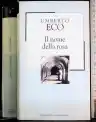
Il nome della rosa
The best-known entry point into Eco's fiction and a strong introduction to his historical imagination, semiotics, and narrative style.
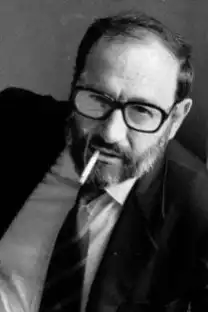
Author guide
Umberto Eco was an Italian scholar and writer whose work ranged across medieval aesthetics, semiotics, literary theory, mass culture, translation, bibliophilia, and fiction. He wrote seven major novels, including The Name of the Rose and Foucault's Pendulum, as well as influential theoretical studies, essay collections, children's books, satirical pamphlets, and illustrated works.
Catalog record updated .
Not sure where to begin?
The best-known entry point into Eco's fiction and a strong introduction to his historical imagination, semiotics, and narrative style.
A foundational work for understanding Eco's theories of interpretation, form, and reader participation.
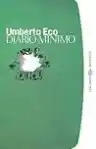
An accessible introduction to Eco's satire, cultural criticism, and comic prose.
Outside the series
nonfiction · 1956
illustrated-nonfiction · 1973
novel · 1980
It is the year 1327. Franciscans in an Italian abbey are suspected of heresy, but Brother William of Baskerville’s investigation is suddenly overshadowed by seven bizarre deaths.
novel · 1988
illustrated-novel · 2004
novel · 2010
"19th-century Europe--from Turin to Prague to Paris--abounds with the ghastly and the mysterious. Jesuits plot against Freemasons. In Italy, republicans strangle priests with their own intestines. In France, during the Paris Commune,…
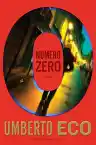
novel · 2015
1945, Lake Como. Mussolini and his mistress are captured and shot by local partisans. The precise circumstances of Il Duce's death remain controversial. 1992, Milan. Colonna, a depressed hack writer, is offered a fee he can't resist to…
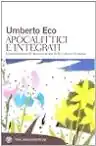
cultural-criticism · 1964
literary-criticism · 1965
literary-criticism · 1971
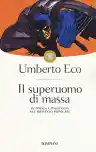
cultural-criticism · 1973
art-criticism · 1973
literary-criticism · 1976
“Questo libro raccoglie una serie di studi scritti in diverse occasioni ed è dominato da una sola idea fissa. Inoltre questa idea non è la mia, ma di Gramsci. L’idea fissa, che giustifica anche il titolo, è la seguente: ‘mi pare che si…
literary-criticism · 1983
linguistic-cultural-history · 1993
philosophy · 1997
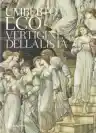
art-history · 2009
cultural-history · 2013
satirical-pamphlet · 1958
essay-collection · 1963
pamphlet · 1976
essay-collection · 1977
pamphlet · 1981
essay-collection · 1983
pamphlet · 1989
essay-collection · 1992
pamphlet · 1996
essay-collection · 1997
essay-collection · 1998
Serendipities is an iconoclastic, dazzlingly erudite and witty demonstration, by one of the world's most brilliant thinkers, of how myths and lunacies can produce historical developments of no small significance. In Eco's words, 'even…
essay-collection · 2000
essay-collection · 2002
pamphlet · 2004
pamphlet · 2005
essay-collection · 2006
pamphlet · 2006
essay-collection · 2011
pamphlet · 2014
essay-collection · 2016
children's-book · 1966
children's-book · 1966
children's-book · 1973
children's-book · 1992
children's-book · 2010
posthumous-essay-collection · 2017
co-authored-nonfiction · 1961
co-authored-nonfiction · 1961
co-authored-cultural-criticism · 1965
co-authored-cultural-criticism · 1972
co-authored-cultural-criticism · 1972
co-authored-literary-criticism · 1979
co-authored-cultural-criticism · 1984
co-authored-dialogue · 1996
A inizio 1995 la rivista Liberal aveva proposto al Cardinal Martini e a Umberto Eco di aprire un dialogo. Questo libretto aveva poi riportato nel 1996 le lettere che i due si erano scambiati, ed era stato tradotto in seguito in sedici…
co-authored-literary-criticism · 1998
co-authored-dialogue · 2005
co-authored-dialogue · 2009
co-authored-dialogue · 2013
aesthetics · 1962
Depuis le début du siècle sont apparues des œuvres qui s'offrent à une pluralité d'organisations: compositions musicales dont les parties sont à enchaîner selon le choix de l'interprète, sculptures mobiles, tableaux informels, jeux…
semiotics · 1967
aesthetics · 1968
semiotics · 1968
semiotics · 1973
semiotics · 1975
illustrated-satire · 1976
literary-theory · 1979
semiotics · 1984
aesthetics · 1987
Tutte le culture hanno avuto un'idea del bello e dell'arte, ma non tutte l'hanno elaborata in forma teorica esplicita, non sempre hanno considerato i due problemi come strettamente connessi e di solito non ne hanno parlato in termini di…
literary-theory · 1990
artist's-book · 1991
bibliophilia · 1992
literary-theory · 1994
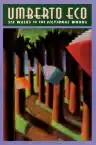
"Come stroll with me through the leafy glades of narrative..." With Umberto Eco as companion and guide, who could resist such an invitation? In this exhilarating book, we accompany him as he explores the intricacies of fictional form and…
translation-theory · 2000
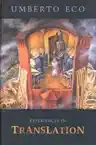
"Translation is not about comparing two languages, Umberto Eco argues, but about the interpretation of a text in two different languages.". "In this book he draws on his substantial practical experience to identify and discuss some…
bibliophilia · 2001
semiotics · 2007
literary-theory · 2011
Umberto Eco was an Italian novelist, semiotician, philosopher, medievalist, literary critic, and university professor. He was especially known for combining scholarly ideas with accessible cultural writing and fiction.
Sources: unibo.it (opens in a new tab)treccani.it (opens in a new tab)
He was born in Alessandria, Italy, on January 5, 1932, and died in Milan on February 19, 2016.
Eco worked in television and publishing, wrote journalism and cultural criticism, and became a leading scholar of semiotics. At the University of Bologna, he helped establish Communication Sciences and founded the School of Advanced Studies in Humanities.
Sources: unibo.it (opens in a new tab)unibo.it (opens in a new tab)
His work was shaped by medieval philosophy and aesthetics, avant-garde art and music, mass communication, and the study of signs. His semiotic theory also drew on linguistics and philosophers including Charles Sanders Peirce.
Source: unibo.it (opens in a new tab)
His novel The Name of the Rose won Italy's Premio Strega, and he later received major honors including the 2000 Prince of Asturias Award for Communication and Humanities. His legacy continues through the University of Bologna's Umberto Eco research and educational institutions, as well as his preserved library and archive.
Sources: premiostrega.it (opens in a new tab)fondazioneumbertoeco.org (opens in a new tab)unibo.it (opens in a new tab)