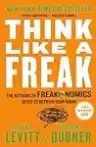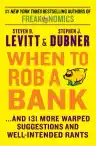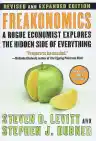
Freakonomics: A Rogue Economist Explores the Hidden Side of Everything
Best introduction to Levitt's popular economics writing and his collaboration with Stephen J. Dubner.

Author guide
Steven D. Levitt is an American economist whose research applies empirical microeconomic methods to crime, education, incentives, discrimination, and other social questions. He is best known as the co-author, with Stephen J. Dubner, of the Freakonomics books and is a professor at the University of Chicago.
Catalog record updated .
Not sure where to begin?
Best introduction to Levitt's popular economics writing and his collaboration with Stephen J. Dubner.

Best starting point for readers seeking Levitt's academic textbook work.
Read in order
book-series · ongoing
A series of popular economics books by Steven D. Levitt and Stephen J. Dubner exploring incentives, behavior, and surprising patterns in everyday life.
Book 1 · nonfiction · 2005
*A Rogue Economist Explores the Hidden Side of Everything* Which is more dangerous, a gun or a swimming pool? What do schoolteachers and sumo wrestlers have in common? Why do drug dealers still live with their moms? How much do parents…
Book 2 · nonfiction · 2009
The New York Times bestselling Freakonomics was a worldwide sensation, selling more than four million copies in thirty-five languages and changing the way we look at the world.Steven D. Levitt and Stephen J. Dubner return with…
Book 3 · nonfiction · 2014
Book 4 · essay-collection · 2015
In celebration of the 10th anniversary of the landmark book Freakonomics FreakonomicsOver the past decade, Steven D. Levitt and Stephen J. Dubner have published more than 8,000 blog posts on Freakonomics.com. Many of them, they freely…
Outside the series
textbook · 2013
Steven D. Levitt is an American economist and professor emeritus at the University of Chicago. He is widely known as the co-author, with Stephen J. Dubner, of the Freakonomics books.
Sources: news.uchicago.edu (opens in a new tab)freakonomics.com (opens in a new tab)
Levitt earned a B.A. in economics from Harvard in 1989 and a Ph.D. in economics from MIT in 1994. He joined the University of Chicago faculty in 1997.
Sources: freakonomics.com (opens in a new tab)news.uchicago.edu (opens in a new tab)
Levitt is known for applying empirical methods and natural experiments to social questions involving crime, corruption, education, politics, and incentives. His research is recognized for using innovative identification strategies to test widely held assumptions.
Sources: news.uchicago.edu (opens in a new tab)aeaweb.org (opens in a new tab)
Levitt received the 2003 John Bates Clark Medal from the American Economic Association. The medal honors an American economist under 40 judged to have made the most significant contribution to economic thought and knowledge.
Sources: aeaweb.org (opens in a new tab)aeaweb.org (opens in a new tab)
In 2003, Dubner wrote an extensive profile of Levitt for The New York Times Magazine. The two then began collaborating, helping bring Levitt’s research to a broad public audience through Freakonomics and related projects.
Sources: news.uchicago.edu (opens in a new tab)freakonomics.com (opens in a new tab)