Le Deuxième Sexe
The defining work of Beauvoir's feminist philosophy and social analysis.
Author guide
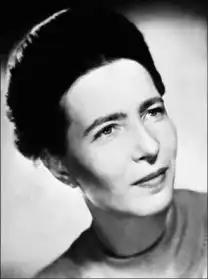
Simone de Beauvoir (1908–1986) was a French writer and intellectual whose work spans existentialist philosophy, feminist theory, fiction, memoir, political nonfiction, literary criticism, drama, and correspondence. Her major works include The Second Sex, the novels She Came to Stay and The Mandarins, and a substantial sequence of autobiographical writings. She also wrote extensively on ethics, aging, colonialism, political responsibility, and women's liberation.
Catalog record updated .
Not sure where to begin?
The defining work of Beauvoir's feminist philosophy and social analysis.

The best entry point to her autobiographical writing and intellectual formation.

An accessible introduction to her existentialist fiction and themes of freedom, jealousy, and responsibility.
Outside the series
novel · 1943
novel · 1945
novel · 1946
When the beautiful, ambitious actress Regina takes Fosca into her life and learns his amazing truth, she is obsessed with the thought that in his memory her performances will live forever. But, as he recounts the story of his immortal…
travel nonfiction · 1948
feminist nonfiction · 1949
novel · 1954
political nonfiction · 1957
novella collection · 1967
social nonfiction · 1970
novel · 2020
memoir · 1958
A superb autobiography by one of the great literary figures of the twentieth century, Simone de Beauvoir's Memoirs of a Dutiful Daughter offers an intimate picture of growing up in a bourgeois French family, rebelling as an adolescent…
memoir · 1960
Vingt et un ans et l'agrégation de philosophie en 1929. La rencontre de Jean-Paul Sartre. Ce sont les années décisives pour Simone de Beauvoir. Celles ou s'accomplit sa vocation d'écrivain, si longtemps rêvée. Dix ans passés à enseigner,…
memoir · 1963
memoir · 1964
memoir · 1972
memoir and interviews · 1981
diary · 1990
diary and journal · 2008
short-story collection · 1979
philosophical essay · 1944
philosophical essay · 1947
essay collection · 1948
essay collection · 1955
play · 1945
co-authored nonfiction · 1962
co-authored correspondence · 2004
correspondence · 1990
correspondence · 1997
Simone de Beauvoir (1908–1986) was a French writer, philosopher, feminist, public intellectual, and activist. She was one of postwar France’s major existentialist figures and a foundational thinker in feminist philosophy.
She studied philosophy, passed France’s competitive agrégation examination in 1929, and taught philosophy in French secondary schools. She later became an editor, political activist, and influential public intellectual.
Her thinking engaged with Descartes, Kant, Hegel, Husserl, Heidegger, Bergson, Marx, and Kierkegaard. She also had a close intellectual partnership with Jean-Paul Sartre, while developing important ideas of her own.
She won the Prix Goncourt in 1954, the Jerusalem Prize in 1975, and Austria’s State Prize for European Literature in 1978.
Sources: academiegoncourt.com (opens in a new tab)jta.org (opens in a new tab)bmwkms.gv.at (opens in a new tab)
Her work helped establish feminist philosophy as a major field and continues to shape feminist theory, existentialism, ethics, and political philosophy. Her influence is evident in the work of later thinkers including Judith Butler, bell hooks, and Sara Ahmed.
Sources: plato.sydney.edu.au (opens in a new tab)guides.loc.gov (opens in a new tab)