Moral Letters to Lucilius (Epistulae morales ad Lucilium)
The fullest sustained presentation of Seneca's practical Stoic ethics and the most accessible entry to his philosophical prose.
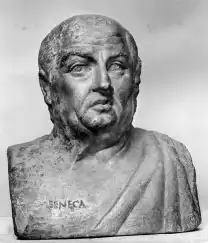
Author guide
Lucius Annaeus Seneca (c. 4 BCE–65 CE) was a Roman Stoic philosopher, political thinker, and dramatist. His surviving corpus comprises moral essays and consolations, the treatise On Benefits, Natural Questions, 124 Moral Letters to Lucilius, the satirical Apocolocyntosis, and a group of tragedies. The authenticity of Hercules Oetaeus and the Apocolocyntosis remains disputed; Octavia is generally excluded as non-Senecan. The corpus and chronology follow scholarly overviews from the Stanford Encyclopedia of Philosophy, Treccani, and the University of Chicago Press complete-works project.
Catalog record updated .
Not sure where to begin?
The fullest sustained presentation of Seneca's practical Stoic ethics and the most accessible entry to his philosophical prose.
A short, self-contained essay that represents Seneca's characteristic moral style and treatment of time, mortality, and philosophical practice.
Outside the series
philosophical treatise · 0056
philosophical treatise · 0063
Lucius Annaeus Seneca (4 BCE–65 CE) was a Roman Stoic philosopher, dramatist, statesman, and advisor to the emperor Nero, all during the Silver Age of Latin literature. The Complete Works of Lucius Annaeus Seneca is a fresh and compelling…
natural-philosophy treatise · 0063
In 'Natural Questions' Seneca expounds & comments on the natural sciences as understood in his day, offering insights to ancient philosophical & scientific approaches to the physical world, as well as vivid evocations of the grandeur,…
philosophical essay · 0041
philosophical essay · 0049
philosophical essay · 0055
philosophical essay · 0058
philosophical essay · 0062
philosophical essay · 0063
consolation · 0040
consolation · 0042
consolation · 0044
satire (disputed attribution) · 0054
Seneca offen referred to as Seneca the Younger was a stoic philosopher in Rome in the first century B C. Besides being a statesman and dramatist, he was a tutor and advisor to Nero. In 65 A D Seneca was caught in a plot to kill Nero.…
letters · 0064
The Moral Letters to Lucilius is a collection of 124 letters which were written by Seneca the Younger at the end of his life, during his retirement, and written after he had worked for the Emperor Nero for more than ten years. They are…
tragedy
tragedy
This is the first full-scale edition in English, with introduction, text, apparatus criticus and commentary, of a play by Seneca: the last edition of any kind appeared over sixty years ago. It's purpose is primarily to elucidate Seneca's…
tragedy
tragedy
tragedy
tragedy
tragedy (disputed attribution)
Lucius Annaeus Seneca, commonly called Seneca the Younger, was a Roman Stoic philosopher, statesman, and writer who lived around 4 BCE to 65 CE.
Sources: plato.stanford.edu (opens in a new tab)penguinrandomhouse.com (opens in a new tab)
Seneca was born in Corduba, in present-day Spain, and was educated in rhetoric and philosophy in Rome.
Seneca served as Nero’s tutor during his adolescence and later became one of his advisers. After retiring from public life, he was compelled to commit suicide in 65 CE.
Seneca worked within the Stoic philosophical tradition, emphasizing its practical use in managing emotions, adversity, ambition, and moral progress.
Seneca remains influential for his practical moral philosophy and for the lasting impact of his tragedies on Renaissance and Shakespearean drama.
Sources: plato.stanford.edu (opens in a new tab)academic.oup.com (opens in a new tab)