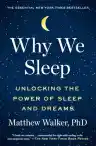
Why We Sleep: Unlocking the Power of Sleep and Dreams
Matthew Walker's first and only standalone book; the natural entry point to his published book-length work.
Author guide
Matthew Walker is a British neuroscientist and sleep researcher who is a professor of neuroscience and psychology at the University of California, Berkeley, where he founded and directs the Center for Human Sleep Science. He is a former professor of psychiatry at Harvard University and has published more than 100 scientific studies. His first book, Why We Sleep, explains the science and importance of sleep and dreaming for general readers.
Catalog record updated .
Not sure where to begin?
Matthew Walker's first and only standalone book; the natural entry point to his published book-length work.
Outside the series
nonfiction book · 2017
“Why We Sleep is an important and fascinating book…Walker taught me a lot about this basic activity that every person on Earth needs. I suspect his book will do the same for you.” —Bill Gates A New York Times bestseller and international…
Matthew Walker is a neuroscientist, author, and professor of neuroscience and biomedical engineering at the University of Texas at Dallas. He directs the university’s Sleep Innovation Laboratories at the Center for BrainHealth.
He is best known for sleep research and for writing *Why We Sleep*, a widely read book explaining the importance of sleep and dreaming.
Sources: be.utdallas.edu (opens in a new tab)news.berkeley.edu (opens in a new tab)
Walker studied neuroscience at the University of Nottingham and earned a PhD in neurophysiology through the Medical Research Council in London. He previously taught at Harvard Medical School and UC Berkeley.
Sources: be.utdallas.edu (opens in a new tab)news.utdallas.edu (opens in a new tab)
His research examines how sleep affects human health and disease, including memory, emotional well-being, and brain function. At UT Dallas, he also develops technologies intended to measure and improve sleep.
Sources: be.utdallas.edu (opens in a new tab)news.utdallas.edu (opens in a new tab)
Yes. He received the 2020 Carl Sagan Prize for Science Popularization for his contributions to public understanding of science, and he is a Kavli Fellow of the National Academy of Sciences.
Sources: news.berkeley.edu (opens in a new tab)be.utdallas.edu (opens in a new tab)