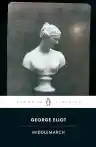
Middlemarch: A Study of Provincial Life
Her most representative and widely studied novel.
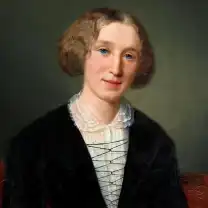
Author guide
George Eliot was the pen name of Mary Ann Evans, an English novelist, poet, essayist, and translator. Her major fiction includes Scenes of Clerical Life, Adam Bede, The Mill on the Floss, Silas Marner, Romola, Felix Holt, the Radical, Middlemarch, and Daniel Deronda. She also published the dramatic poem The Spanish Gypsy, the poetry collection The Legend of Jubal and Other Poems, and the satirical essay collection Impressions of Theophrastus Such.
Catalog record updated .
Not sure where to begin?
Her most representative and widely studied novel.
Outside the series
novel · 1859
Adam Bede is a hardy young carpenter who cares for his aging mother. His one weakness is the woman he loves blindly: the trifling town beauty, Hetty Sorrel, whose only delights are her baubles-and the delusion that the careless Captain…
novel · 1860
From the author of MIDDLEMARCH and SILAS MARNER, a story of frustrated intelligence and longing, featuring the intelligent Maggie, who yearns to be loved, and her brother Tom, who is forced to study. When Maggie is cast out by Tom, she is…
novel · 1861
Eliot's touching novel of a miser and a little child combines the charm of a fairy tale with the humor and pathos of realistic fiction. The gentle linen weaver, Silas Marner, exiles himself to the town of Raveloe after being falsely…
novel · 1863
Eliot’s only historical novel, set in 15th century Florence under the rule of the Medicis, blends fact with fiction as the reader follows the almost saint-like Romola and the amoral and feckless Tito Melema whom she marries against the…
novel · 1866
novel · 1871
Eliot’s epic of 19th century provincial social life, set in a fictitious Midlands town in the years 1830-32, has several interlocking storylines blended effortlessly together to form a fully coherent narrative. Its main themes are the…
novel · 1876
As Daniel Deronda opens, Gwendolen Harleth is poised at the roulette-table, prepared to throw away her family fortune. She is observed by Daniel Deronda, a young man groomed in the finest tradition of the English upper-classes. And while…
short-story-collection · 1858
When Scenes of Clerical Life, George Eliot's first novel, was published anonymously in 1857, it was immediately recognized, in the words of Saturday Review, as `the production of a peculiar and remarkable writer'. The three stories that…
essay-collection · 1879
dramatic-poem · 1868
poetry-collection · 1874
George Eliot was the pen name of Mary Ann Evans, an English novelist, poet, translator, editor, and critic of the Victorian era.
Source: npg.org.uk (opens in a new tab)
Evans adopted the pseudonym to preserve her anonymity and to help her writing be taken seriously in a male-dominated literary culture.
Source: npg.org.uk (opens in a new tab)
Before publishing fiction, she worked as a translator, reviewer, and editor, including an important role at the radical Westminster Review. Her early translation of D. F. Strauss’s Life of Jesus Critically Examined appeared in 1846.
Her thinking was shaped especially by Spinozism, Romanticism, and the wider European philosophical tradition, including German religious and philosophical writing.
Her works remain widely read, and her sophisticated treatment of morality, sympathy, society, and psychology influenced later writers and helped shape modern philosophical and literary fiction.