Manifesto of the Communist Party
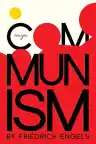
The concise foundational statement of Marxist political theory, co-authored with Karl Marx.
Author guide
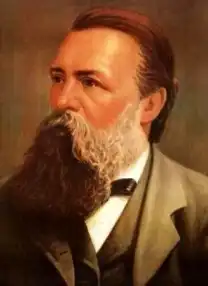
Friedrich Engels (1820–1895) was a German philosopher, political theorist, historian, and revolutionary socialist. Drawing on his experience of industrial Manchester, he developed influential analyses of capitalism and the working class and collaborated closely with Karl Marx on the foundations of Marxist theory. Engels wrote major works on political economy, socialism, history, anthropology, philosophy, science, and military affairs, while also editing and completing Marx's posthumous manuscripts for Capital.
Catalog record updated .
Not sure where to begin?
The concise foundational statement of Marxist political theory, co-authored with Karl Marx.
A short, accessible introduction to Engels's account of socialism and historical materialism.
Engels's major early study of industrial capitalism and working-class life.
Outside the series
pamphlet · 1914
In 1847 Engels wrote two draft programmes for the Communist League in the form of a catechism, one in June and the other in October. The latter, which is known as Principles of Communism, was first published in 1914. The earlier document…
pamphlet · 1848
The political tract in which Marx presented the core of his philosophy and revolutionary program.
pamphlet · 1859
pamphlet · 1859
pamphlet · 1865
pamphlet · 1872
pamphlet · 1880
**Socialism: Utopian and Scientific** is a short book first published in 1880 by German-born socialist Friedrich Engels. The work was primarily extracted from a longer polemic work published in 1878, Anti-Dühring. It first appeared in the…
pamphlet · 1886
book · 1845
Written when Engels was only 24, and inspired by his time living among the poor in Manchester, this forceful polemic explores the staggering human cost of the Industrial Revolution in Victorian England.
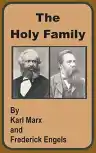
book · 1845
During Engels' short stay in Paris in 1844, Marx suggested the two of them should write a critique of the rage of their day, the Young Hegelians. In the doing was born the first joint writing project between the two men -- and a life-long…
book · 1932
2011 Reprint of 1939 Edition. Parts I & III of "The German Ideology." Full facsimile of the original edition, not reproduced with Optical Recognition Software. Originally published by the Marx-Engels Institute in Moscow in 1939. "The…
book · 1850
book · 1896
book · 1878
Marx and Engels first became aware of Professor Dühring with his December 1867 review of Capital, published in Ergänzungsblätter. They exchanged a series of letters about him from January-March 1868.He was largely forgotten until the…
collection · 1881
book · 1884
The Origin of the Family, Private Property and the State (1884), was a provocative and profoundly influential critique of the Victorian nuclear family. Engels argued that the traditional monogamous household was in fact a recent…
collection · 1925
This is a new edition of Engels' main work on Marxist theory.
Friedrich Engels (1820–1895) was a German philosopher, political theorist, journalist, businessman, and revolutionary socialist. He is best known as Karl Marx’s close collaborator and a co-founder of Marxism.
Source: dhm.de (opens in a new tab)
Engels was born on 28 November 1820 in Barmen, now part of Wuppertal, Germany. He died in London on 5 August 1895.
Source: dhm.de (opens in a new tab)
Engels and Marx began a lifelong intellectual and political partnership in 1844. They collaborated on the Communist Manifesto, and Engels later helped complete and publish Marx’s unfinished work on Capital.
Sources: dhm.de (opens in a new tab)unesco.org (opens in a new tab)
Engels worked in his family’s cotton business in Manchester from 1842 to 1844 and was deeply affected by the harsh conditions faced by industrial workers. His observations there informed his influential analysis of working-class life.
Sources: manchester.ac.uk (opens in a new tab)dhm.de (opens in a new tab)
Engels helped shape Marxist social and economic theory and had a lasting influence on socialist, communist, and other revolutionary movements. His collaboration with Marx and his posthumous editorial work on Capital remain central to his historical legacy.
Sources: unesco.org (opens in a new tab)dhm.de (opens in a new tab)