Discourses
The Discourses preserve the fullest surviving record of Epictetus's teaching and provide the essential context for the shorter Enchiridion.
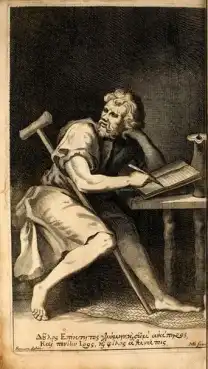
Author guide
Epictetus was born in Hierapolis in the 50s CE and spent part of his early life enslaved in Rome. After studying with Musonius Rufus and gaining his freedom, he taught Stoic philosophy in Rome and later established a school at Nicopolis in Epirus. He died around 135 CE. Epictetus left no known writings in his own hand. His surviving philosophical corpus consists chiefly of Arrian's records of his teaching in the Discourses and Arrian's abridgment of that material in the Enchiridion, also known as the Handbook or Manual. The Discourses survive in four books, while the original work probably comprised eight or more. A small number of fragments survive through quotations by later authors.
Catalog record updated .
Not sure where to begin?
The Discourses preserve the fullest surviving record of Epictetus's teaching and provide the essential context for the shorter Enchiridion.
The Enchiridion is a concise introduction to Epictetus's central ethical principles and can be read independently.
Outside the series
nonfiction · 0108
nonfiction · 0108
The Enchiridion or Manual of Epictetus is a short manual of Stoic ethical advice compiled by Arrian, a 2nd-century disciple of the Greek philosopher Epictetus.Although the content is similar to the Discourses of Epictetus, it is not a…
Epictetus was a Greek Stoic philosopher born in Hierapolis in Asia Minor sometime in the 50s CE. He spent part of his early life enslaved in Rome and died around 135 CE.
After teaching in Rome, Epictetus left when Emperor Domitian expelled philosophers from Italy. He established a school at Nicopolis in Epirus, where he taught until his death.
Epictetus studied under the Stoic teacher Musonius Rufus and drew heavily on earlier Stoic thinkers such as Zeno, Cleanthes, and Chrysippus. He was also strongly inspired by the Socrates portrayed in Plato’s dialogues.
The surviving record of Epictetus’s teaching was compiled by his pupil Arrian. The major compilation was based on Epictetus’s oral instruction rather than written works known to be authored in his own hand.
Epictetus remains influential because he presented Stoicism as a practical discipline centered on freedom, judgment, self-command, and ethical development. His teachings affected figures such as Marcus Aurelius and later European thinkers, and they continue to receive substantial scholarly attention.
Sources: plato.stanford.edu (opens in a new tab)academic.oup.com (opens in a new tab)