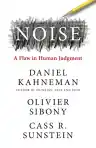
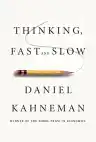
Daniel Kahneman (1934–2024) was an Israeli-American psychologist whose research with Amos Tversky transformed the study of human judgment and decision-making. He received the 2002 Nobel Memorial Prize in Economic Sciences for integrating psychological insights into economics, especially concerning judgment and decision-making under uncertainty. His work helped establish behavioral economics and advanced prospect theory, the study of heuristics and biases, and dual-process accounts of cognition. Kahneman was a professor at Princeton University and authored Attention and Effort and Thinking, Fast and Slow; he later co-authored Noise with Olivier Sibony and Cass R. Sunstein.
Show how noise produces errors in many fields, including in medicine, law, public health, economic forecasting, forensic science, child protection, creative strategy, performance review and hiring
Not sure where to begin?
Start with one of these
Thinking, Fast and Slow
The best entry point to Kahneman's major ideas about intuitive and deliberate thinking, judgment, decision-making, heuristics, biases, and prospect theory.
In this work the author, a recipient of the Nobel Prize in Economic Sciences for his seminal work in psychology that challenged the rational model of judgment and decision making, has brought together his many years of research and…
Show how noise produces errors in many fields, including in medicine, law, public health, economic forecasting, forensic science, child protection, creative strategy, performance review and hiring
Frequently asked questions about Daniel Kahneman
When and where was Daniel Kahneman born?
Daniel Kahneman was born on March 5, 1934, in Tel Aviv, then in Mandatory Palestine, and grew up partly in France. He later became an Israeli-American psychologist and economist.
What was Daniel Kahneman's professional background?
Kahneman was a psychologist whose research transformed the study of judgment and decision-making. He held academic appointments at Hebrew University, the University of British Columbia, and the University of California, Berkeley, before joining Princeton University.
Amos Tversky was Kahneman's most important intellectual collaborator; together they developed influential research on judgment under uncertainty and decision-making. Their partnership also shaped the behavioral-economics field.
Kahneman received the 2002 Nobel Memorial Prize in Economic Sciences for integrating psychological insights into economic science, especially human judgment and decision-making under uncertainty. He also received the Presidential Medal of Freedom in 2013.
Kahneman helped establish behavioral economics by showing how cognitive biases and heuristics systematically affect human judgment and choice. His work continues to influence economics, psychology, public policy, medicine, and business.