In Which Annie Gives It Those Ones
screenplay · First published 2026

Author guide
Arundhati Roy is an Indian writer and activist whose work spans fiction, political essays, reportage, memoir, interviews, and screenwriting. Her debut novel, The God of Small Things, won the 1997 Booker Prize. Her nonfiction addresses nationalism, caste, militarism, corporate power, globalization, democracy, environmental displacement, and Kashmir. She studied architecture in New Delhi and lives in Delhi.
Catalog record updated .
screenplay · First published 2026
Not sure where to begin?
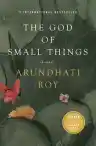
Roy's Booker Prize-winning debut and clearest entry point to her fiction.
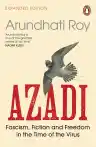
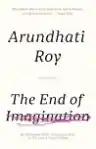
A concise entry point to her later political essays.
Outside the series
novel · 1997
The year is 1969. In the state of Kerala, on the southernmost tip of India, a skyblue Plymouth with chrome tailfins is stranded on the highway amid a Marxist workers' demonstration. Inside the car sit two-egg twins Rahel and Esthappen,…
novel · 2017
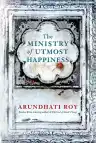
The Ministry of Utmost Happiness takes us on an intimate journey of many years across the Indian subcontinent—from the cramped neighborhoods of Old Delhi and the roads of the new city to the mountains and valleys of Kashmir and beyond,…
memoir · 2025
A raw and deeply moving memoir from the legendary author of The God of Small Things and The Ministry of Utmost Happiness that traces the complex relationship with her mother, Mary Roy, a fierce and formidable force who shaped Arundhati’s…
pamphlet · 1998
Five books of essays in one volume from the Booker Prize–winner and “one of the most ambitious and divisive political essayists of her generation” (The Washington Post). With a new introduction by Arundhati Roy, this new collection begins…
essay-collection · 1999
Describes how India's ambitious dam projects created suffering along with modernization.
pamphlet · 1999
essay-collection · 2002
This collection of Arundhati Roy’s early political essays ranges from the iconic ‘The End of Imagination’ and ‘The Greater Common Good’ about India’s nuclear tests and the dam industry to the equally influential ‘The Algebra of Infinite…
essay-collection · 2003
essay-collection · 2004
essay · 2004
essay-collection · 2009
essay-collection · 2011
On Naxalite movement and Indian state's counter insurgency methods and other policies.
essay-collection · 2013
essay · 2014
"From the poisoned rivers, barren wells, and clear-cut forests, to the hundreds of thousands of farmers who have committed suicide to escape punishing debt, to the hundreds of millions of people who live on less than two dollars a day,…
essay-collection · 2020
The chant of 'Azadi!' - Urdu for 'Freedom'-is the slogan of the freedom struggle in Kashmir against what the Kashmiris see as the Indian Occupation. Ironically, it also became the chant of millions on the streets of India against the…
screenplay · 2026
co-authored-essay-collection · 2011
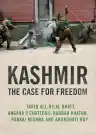
Kashmir is one of the most protracted and bloody occupations in the world -- and one of the most ignored. Under an Indian military rule that, at half a million strong, exceeds the total number of US forces in Iraq and Afghanistan, freedom…
co-authored-essay-and-conversation · 2016
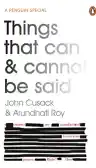
In this rich dialogue on surveillance, empire, and power, Roy and Cusack describe meeting NSA whistleblower Ed Snowden in Moscow.
interview-collection · 2008
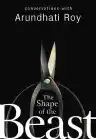
The Shape Of The Beast Is Our World Laid Bare, With Great Courage, Passion And Eloquence, By A Mind That Has Engaged Unhesitatingly With Its Changing Realities, Often Anticipating The Way Things Have Moved In The Last Decade. In The…
reportage · 2011
From the award-winning author of The Ministry of Utmost Happiness and The God of Small Things comes a searing frontline exposé of brutal repression in India In this fiercely reported work of nonfiction, internationally renowned author…
Arundhati Roy is an Indian author whose career spans fiction, essays, screenwriting, and political activism. She became internationally known after her first novel won the 1997 Booker Prize and later became prominent for socially engaged nonfiction and human-rights advocacy.
Sources: thebookerprizes.com (opens in a new tab)sydneypeacefoundation.org.au (opens in a new tab)
She was born in Shillong in northeastern India and grew up mostly in Kerala on India’s southwestern coast.
She studied architecture in New Delhi, then worked in cinema as an actress and screenwriter. Her screenplay for In Which Annie Gives It Those Ones earned the National Film Award for Best Screenplay.
Sources: aub.edu (opens in a new tab)loc.gov (opens in a new tab)
Roy has described her multilingual upbringing in Kerala and early reading of Shakespeare and Kipling as formative; she has also cited James Baldwin, Toni Morrison, Maya Angelou, John Berger, Joyce, and Nabokov as later influences.
She won the 1997 Booker Prize for The God of Small Things—the first Indian winner—and the 2004 Sydney Peace Prize for human-rights campaigning and advocacy of nonviolence. Her legacy joins innovative literary writing with sustained public engagement on social, economic, and environmental justice.
Sources: thebookerprizes.com (opens in a new tab)sydneypeacefoundation.org.au (opens in a new tab)