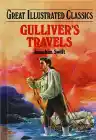
Gulliver's Travels
Swift's best-known satirical novel and the most accessible entry to his fiction.
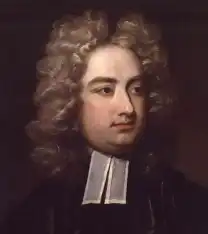
Author guide
Jonathan Swift (1667–1745) was an Anglo-Irish writer and Anglican clergyman who served as Dean of St Patrick's Cathedral, Dublin. Writing anonymously and under numerous pseudonyms, he produced satirical fiction, poetry, political and religious pamphlets, essays, sermons, memoirs, correspondence, and works on Irish affairs. His major works include A Tale of a Tub, Gulliver's Travels, the Drapier's Letters, A Modest Proposal, and A Complete Collection of Genteel and Ingenious Conversation.
Not sure where to begin?
Swift's best-known satirical novel and the most accessible entry to his fiction.
A foundational early satire that introduces Swift's prose style and intellectual concerns.
A short, self-contained example of Swift's political and satirical writing.
Read in order
pamphlet-series · completed
Swift's satirical pamphlets and collections written under the pseudonym Isaac Bickerstaff, chiefly targeting astrologer John Partridge and related credulity.
Book 1 · pamphlet · 1708
Book 2 · pamphlet · 1708
Book 3 · poetry · 1708
Book 4 · pamphlet · 1709
Book 5 · pamphlet · 1709
Book 6 · collection · 1720
letter-series · completed
Swift's separately issued political letters opposing William Wood's Irish halfpence scheme, published under the pseudonym M. B. Drapier.
Book 1 · political-writing · 1724
Book 2 · political-writing · 1724
Book 3 · political-writing · 1724
Book 4 · political-writing · 1724
Book 5 · political-writing · 1724
Book 6 · political-writing · 1724
Outside the series
nonfiction · 1701
nonfiction · 1709
novel · 1726
nonfiction · 1732
nonfiction · 1745
pamphlet · 1693
essay · 1707
essay · 1708
pamphlet · 1709
essay · 1710
pamphlet · 1711
pamphlet · 1711
essay · 1712
pamphlet · 1712
essay · 1720
sermon · 1754
essay · 1758
poetry · 1719
poetry · 1726
poetry · 1733
poetry · 1734
poetry · 1734
poetry · 1736
poetry · 1738
poetry · 1738
poetry · 1739
satire · 1704
collection · 1711
political-writing · 1711
political-writing · 1712
political-writing · 1712
political-writing · 1714
political-writing · 1720
religious-writing · 1720
religious-writing · 1721
religious-writing · 1723
collection · 1725
political-writing · 1728
political-writing · 1728
political-writing · 1729
satire · 1729
religious-writing · 1732
religious-writing · 1732
political-writing · 1732
satire · 1733
religious-writing · 1733
political-writing · 1736
political-writing · 1737
dialogue · 1738
political-writing · 1741
satire · 1746
correspondence · 1766